_edited.jpg)


Breath and Bow
Endangered musical instruments of Rajasthan
THE LAST ONES
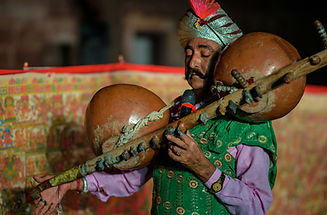
An eleven-year-old boy plays on the courtyard-like terrace of his home—a modest yet dignified house, built just some decades ago. Javed is the only minor in the world still playing the Kamaicha. Perhaps only because his father watches over him like a hawk: a devoted teacher, sharp with talent, yet burdened with a quiet dread—the fear of losing the cultural heritage of their family, their community, and of Rajasthan itself.
Javed lives in the village of Hamira, tucked away in the desert just beyond Jaisalmer. A newly built road now winds its way to this quiet place—not merely a stretch of asphalt, but a ribbon of remembrance. It stands as a tribute to Javed’s grandfather, Padma Shri awardee and legendary musician, the late Sakar Khan. Born into a lineage of Manganiyar musicians, Sakar Khan rose to national prominence in the last century as one of the few remaining Kamaicha players. In his hands, the instrument became more than wood and string—it became the breath of the desert. His music carried the soul of his people far beyond the sands, echoing across continents.
Despite his fame, the instrument—and everything it carries—is now at risk.


Javed’s story is part of a larger and urgent narrative—the story of “the last ones.” He is the only boy left who plays the Kamaicha. Just a few blocks from his home lives the last man who still knows how to make the instrument: an elderly craftsman, who works with wood, goat skin, and horsehair. He shapes each piece with reverence, but the weight of extinction sits heavily on his tools. To keep the tradition breathing, he constructs miniature “toy Kamaichas,” hoping to spark interest in his younger brother. But the craft is no longer viable, nor is it in demand.
Travel across Rajasthan and the pattern repeats. In one village, the haunting Sindhi Sarangi still resonates, despite its disappearing makers. Nearby, the Algoza's melody lingers with the last family of players. Across the region, the echoes of Been and Pungi faintly fill the air, as their craftsmen strive to preserve tradition amid changing times.
When we return to Hamira, and to Javed’s father, we see that the Kamaicha and the man have become one. His hands, hardened by years of playing, move with a force that sings. His belly has grown to echo the roundness of the instrument’s resonating chamber. This is not coincidence, but kinship.
To take away the instrument from the man who plays it, who sings stories through it, is to take away his voice.
His identity.
His very being.
These are not stories of nostalgia. They are warnings. They are calls to action. Because when the last ones fall silent, so do centuries of song.
Problem
Rajasthan’s musical tradition is not just performance, it is identity, it is history, and it is an ecosystem of oral knowledge passed down from generation to generation. Each community carries their own repertoire, rooted in their intimate relationship with the land, pastoral migrations, and oral lore. And each of these songs lived through an instrument crafted by hand, played by lineage, remembered by the land. Today, that tradition faces critical endangerment.

Loss of tradition
Instruments like Kamaicha, Algoza, Surna, Sarinda define not just sound, but context. They give the music its shape, its peculiar cadence, its emotional pitch. They carry techniques and repertoires that are passed down orally, refined over generations. When Instruments vanish, songs lose their roots, their dialects, their soul. Replacing them with harmoniums and tablas–however accessible and convenient–homogenizes centuries of diverse sonic cultures into a diluted and decontextualized performance.
_edited.jpg)
Erosion of Livelihoods
The musical loss is economic too. Instrument makers and hereditary musicians, already marginalised, are pushed further into the peripheries. Their work, no longer in demand, becomes unsustainable. The younger generation, seeing no future in craft or performance, turns away. A cycle of disinheritance begins.

In between heritage and aspirations
Many young musicians today are caught between reverence for their heritage and a pressure to modernise. They are encouraged to play the more universally palatable bollywood covers instead of folk ballads, to swap the sarangi with a harmonium. This dissonance creates a void, where tradition is too heavy to carry, but too sacred to discard.
Research
-
With the musicians, we document the instruments, playing technique and the entire repertoire.
-
With the artisans, we study the instrument making to understand the process of production.
-
With our technician team, we identify and design interventions to make production easier, less costly and sustainable.
Interventions
-
Community Concerts : we organise unplugged concerts with senior artists to re-highlight these instruments and their repertoire.
-
Jamming Sessions: we conduct a multi-community ‘jamming’ session where new friendships, songs and ideas are forged.
-
Hathaai: we create awareness amongst the local population and tourists on the rich musical tradition of Western Rajasthan.

Deliverables
-
Interactive hub in the core villages of each instrument with a crafts studio, a shop cum exhibition space and a training space for artists.
-
Strings and Winds music Festival and Conference open for all (can be monetized)
-
Publications in academic journals, popular online and print magazines, books
-
A digital archive containing documentation of all instruments, players, repertoires.
-
A documentary film
Impact
-
Increase recognition on the ground, in Rajasthan, nationally and globally for local artists, instruments and songs
-
Create, nurture and expand market for local instruments and music
-
Increase the number of artists who play traditional musical instruments
-
Make production process for musical instruments easier, sustainable and profitable
-
Garner recognition with awards, publications, and outreach programs